|
By Anonymous (published in gfamissions.org/c0/reaching-the-darlenes/)  I saw another Darlene just yesterday. This one was riding in a crude handmade wooden cart full of various flattened soda bottles and smashed, used cardboard boxes for recycling. Like most Darlenes, she had a plaid shirt that was too short, unmatching pants with an imitation design of some Disney princess, and her hair uncombed. Unaware of her vast disadvantages in life, she was cheerfully playing with the items in the bumping cart while her mother walked the streets of our Asian city, scouring garbage piles. I remember the first time I laid eyes on the original Darlene. She had blended into the crowd of children coming to our Sunday school that morning. With their chairs crammed together, Darlene’s peanut size kept her as invisible as possible. During the Sunday morning routine, I brought out an animal puppet, which never fails to delight the children. After saying its piece to advertise the Bible story, the puppet usually enjoys being petted. “Would Charles like to pet the dog? How about Annabelle? And what is YOUR name, little girl?” I asked, as her wide brown eyes stared up at me. She didn’t move or say anything. As the other children chimed in on her name, I kept wondering why she had a dark bruise on her forehead, and why was a child so young sent to Sunday school without a parent to watch over her? She was surely not more than three years old. Darlene returned the next week, and the next. Each week it seemed she had a scab on her cheek in a different place, or sores on her legs where she evidently had a skin condition. I remember well my first visit to Darlene’s home one extremely hot Sunday afternoon. We asked one of her siblings playing on the street where we could find their family. We stepped over wet garbage, shards of glass, and splintered boards to get to the metal ladder, rungs far apart, to climb to their second-floor home. Could this explain some of the bruises and cuts on Darlene? We climbed over a large, unexplained rock that guarded their front door threshold, and we sat on the floor since there were no chairs. We had a Bible study with Darlene’s aunt, who had just finished hanging the hand-washed laundry—inside. We listened to the drips of water falling from the clothes while my eyes strayed to the wide bed, hidden partly by hanging clothes. Three pairs of feet indicated three sleeping family members snoozing in the steamy heat while we talked. Was there any hope for a family like this? Darlene’s father had left them, and her mother worked six days a week to try to keep food on the table. Although my heart melted for Darlene, I soon found out that she was unfamiliar with how to show and receive love. So, I started by remembering her name. When she entered the church in a crowd of noisy children flowing up the stairs, I called out her name and touched her head. At first, she was just confused by this. But after a few weeks, she met my eyes and reached out her hand although she didn’t smile at all. Our church ladies held a campaign to delouse the children, and when it was Darlene’s turn to have her head scrubbed, she enjoyed the attention. Surprisingly, her hair came out a dark shade of brown, rather than the black with which we were familiar. A few months after I met Darlene, we decided to start an official toddler Sunday school in our church. Every week we would sing a welcome song that included all the names of the children in our class. Darlene loved to hear her name and easily memorized all the songs we sang, especially if she could ring a little jingle bell along with the song. I soon found out how smart and observant her little mind was. When I told the story of Noah, she asked me why two monkeys got on the ark in one picture, but no monkeys got off after the flood? Of course, I never noticed that in the busy zoo-like picture of animals! When we sang about God’s attributes, we would point to our heads, “God knows, God knows, all the time.” But Darlene was confused and pointing to her nose asked, “Teacher? Why do we point to our heads and say, ‘God nose,’ when our noses are right here?” When Darlene learned color names, she was eager to point out that the daughter of Pharaoh was wearing a bright pink dress. This was Darlene’s favorite color, and so it 2/3 was quite distracting to her in the story of baby Moses. A tough lesson for Darlene to learn was about herself. Like every human, Darlene wanted her own way. If I did not allow her to hold the song chart or pet the puppet first, she would bend over and hide her face in her legs, refusing to participate in Sunday school. We had to explain that she could not enjoy Sunday school while she had a bad attitude, so she would need to sit aside until she could obey. She did not like this ultimatum at all, and it took her several weeks to learn how to make good decisions about her behavior. Once Darlene reached the age of four, I began including simple explanations of the Gospel each week. When the children lost interest and couldn’t answer the questions, I became discouraged. There are too many abstract ideas in the Gospel, I decided. One week, Darlene came to Sunday school and gave me her customary bear hug around my knees, “Hello Darlene!” I said, beaming, just like I do every week. We sang our same songs, we had our Bible story and rang our bells, said the memory verse, and petted the puppet. But when I got to the gospel explanation, I showed the picture of the heart with tears on it. “What does this picture remind us of?” I asked again. This time Darlene turned smartly to her classmate, and with a know-it-all, big-sister attitude, she declared firmly, “Aidon, YOU are a sinner! I am a sinner, and even Teacher is a sinner, because we are ALL sinners!” Aidon didn’t look very happy about this accusation, but inside my heart I was thinking that there is certainly hope for Darlene. There is hope for all who will recognize their guilt before God and repent, knowing Christ is their only hope of a Savior. I pray for Darlene every single day. I am trying to do what I can to bring Darlene to Christ. However, as I go about my weekly routines, walking in our neighborhood in a city of two million clustered with cities that equal 14 million residents, I see Darlenes everywhere. They are ignorant of their physical disadvantages and ignorant of their spiritual trajectory, and the question goes through my mind, “Lord, who will reach THAT Darlene? Please send someone to her.” Where BJMBC Stands8/13/2020 By BJMBC Faculty Four identifiers that mark where BJMBC stands  Where BJMBC StandsWe live in a time when leaders, organizations, denominations, and churches are changing. Change is not inherently wrong. None of us brings a bullock to a tent on Saturday, cuts its throat, and offers it on an altar! On the other hand, change can be in the wrong direction. Sadly, the church that Jesus Christ said He would build sometimes does move away from Him instead of toward Him. The next several blogs will help you understand where BJMBC stands and the kinds of changes we are not willing to make. Let's start with a clarification related to our name. Obviously, our name connects us to Bob Jones University. After all, we are Bob Jones Memorial Bible College. Sometimes people mistakenly assume some organic connection between us and Bob Jones University. Actually, there is no official connection between BJMBC and BJU. We receive no financial help from BJU. We are not an Asian branch or extension of BJU. We are not under the administrative oversight of BJU. Not in any way. Our name does not reflect official attachment but rather the appreciation by BJMBC's founders for what they received at BJU years ago. They especially appreciate the heritage put in place by Bob Jones Sr. We at BJMBC do too. Bob Jones Sr. stood for an uncompromising stand on and preaching of the gospel. If you want to catch his heartbeat, watch this video about the life and legacy of Bob Jones. Rather than being a ministry of BJU, BJMBC is actually a ministry of Gospel Fellowship Association. Understanding where GFA stands will help you understand where we stand. The following excerpt from the GFA website explains their stand on "fellowship." "GFA missionaries practice both ecclesiastical and personal separation and compassionately warn about deviation from biblical truth and practice. We partner with independent Baptist and other like-minded churches that practice believer’s baptism by immersion. We are committed to a reverent, conservative worship style. We are also cessationists, believing the sign gifts have ceased." The excerpt above suggests at least four identifiers to clarify where both GFA and BJMBC (a ministry of GFA) stand.
1. We are committed to the doctrine of separation and identify with the fundamentalist movement. First, we are committed to the doctrine of separation, which means we identify ourselves as fundamentalists or part of the movement known as fundamentalism. In the Philippines context, this can be a bit confusing since there is a fellowship of Baptist churches (Association of Fundamental Baptist Church of the Philippines) that call themselves "Fundamental.” By referring to ourselves as part of fundamentalism, we are not alluding to this specific fellowship of Baptists, although we hold common cause with the conservative constituents of AFBCP on many issues, but rather we are identifying ourselves with the larger fundamentalist movement. 2. We identify specifically with Baptist fundamentalism. Second, we identify with Baptist fundamentalism. Historic fundamentalism actually included Presbyterians, Methodists, and others who held staunchly to the fundamentals of the faith. Believe it or not there were and are fundamental Presbyterians! But we identify more closely with Baptist fundamentalism, which includes independent Baptist churches and likeminded independent Bible churches. Even though GFA does not have Baptist in its name (and neither does BJMBC), our statement of faith is decidedly Baptistic and virtually all of us identify ourselves as Baptist in faith and practice. For example, every director at BJMBC is a member of a Baptist church. The director of GFA is a member of a Baptist church. And the list could go on. 3. We are conservative in our style of worship. Third, we are conservative in our style of worship. We oppose the contemporary forms of worship often associated with so-called “Praise & Worship.” We are not opposed to recently composed music by conservative composers. We are very supportive of these composers. We stand against contemporary forms of worship that imitate the world such as CCM and its musical cousins. Reverent implies worship that reflects and honors the character of our thrice-holy God. Worship clarifies that the music is for God's enjoyment, not necessarily ours. Musical styles and lyrics that deliberately imitate that of the world surely do not bring enjoyment to a God who has said that friendship with the world is enmity with Him. 4. We are cessationist. Lastly, we are cessationist. We believe that the kinds of apostolic signs and wonders that God worked during the founding era of the church have ceased (thus, the term cessationist). So we disassociate ourselves from the charismatic and/or Pentecostal churches that still look for signs and wonders. Also, a pursuit of signs and wonders often goes along with seeking some kind of second blessing that will catapult its recipient into a higher level of Christian living--almost as if some blessing was missing at the moment of salvation. Spirit baptism now occurs at the moment of salvation, and we have already received the indwelling Spirit and every blessing in heavenly places in Christ. Now we seek to work out this glorious salvation into our daily Christian lives. It is a privilege to stand on the side of God and truth, is it not? It is also a grave responsibility. Over the centuries, ministers and lay people alike have toiled and suffered, sometimes terribly, in order to pass biblical Christianity on to the generations after them. May God help us in our day to hold fast the pattern of sound words (2 Tim. 1:13) and pass it on undiluted to the generations that will come after us!
0 Comments
Dr. Joel Arnold is on the Bible faculty at BJMBC.  LUKE 2:8-20 Whatever else we would say about Luke’s story of the angels and the shepherds, it’s definitely memorable. But less clear is the point. Why did it happen? What does it mean? I’m going to argue that there’s something huge going on here. I’m going to argue that this event was a teaser—a short preview of what the Messiah would do. It’s proof that someday people and angels will worship side by side, giving glory to this newborn child. But I’m getting ahead of myself. Angels can worship too.Let’s start by turning the camera around from how we normally view the scene. Why do we always see it completely from the viewpoint of the humans—the shepherds? Look at it not from the view of the men on the ground, but the angels in front of them. Several things come to mind:
Now put that into the grid of what happened here. Angels were there when Satan fell. Angels saw the good creation and man’s subsequent fall into sin. For thousands of years they watched people wallow in the filth and horror of sin. And yet they were also sent to deliver promises—the hope of a redeemer who would finally deliver mankind from death and sin (Gen 18:1–15; Heb 2:2). They worshipped the Son in heaven’s throne room for thousands of years (Dan 7:10). Then, one day, the glorious Son takes flesh and is conceived in the body of a Jewish woman. An angel delivers the news to Mary (Luke 1:26–38). Nine months later, angels are commissioned to share the grand announcement. After millennia of waiting, hoping and watching, the horror of this wicked world will come to an end. The promise has arrived. The Messiah is here. Are these angels dispassionately relaying information like heavenly robots? Or should we not remember Peter’s words that the angels also longed to look into God’s masterful plan? They also marveled and wondered at the Old Testament prophecies about “Christ’s sufferings and the glory to follow” (1 Pet 1:10–12). Take even a cursory look at their words, and you’ll discover that the announcement comes straight from the Old Testament! 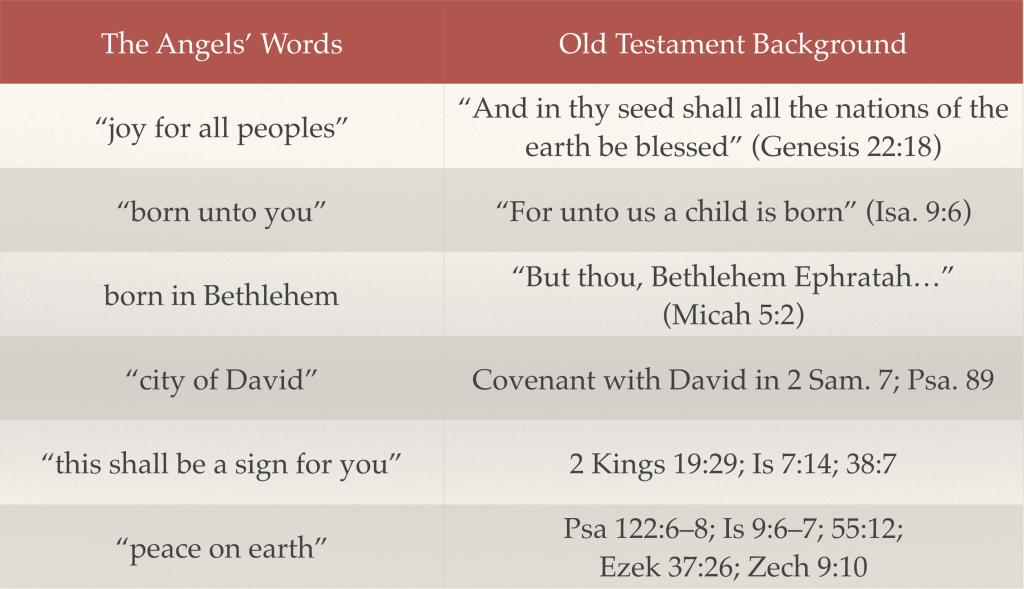 What are these angels doing? They’re worshipping! They themselves are in awe at what God has starting doing and they can’t help crying out with joy. Shepherds Join the Heavenly WorshipNow consider the shepherds. Classic art, Sunday school papers, and scenic calendars all get it wrong:
To this point in the story we can be shocked by the contrast. A throng of heavenly beings before a few shepherds? A dark, quiet hillside suddenly transformed by blazing light? The angels have come from the grand splendor of heaven and now they stand in the squalor of a sin-sick earth. Heaven Meets EarthAnd yet this contrast—heaven vs. earth—stands at the center of the story. It’s in the poetry that the angels sing.  Heaven has been full of glory for thousands of years. Earth has been a horror of sin and its consequences. Until now. Because through the Messiah, at last, peace has come. We discover that this brief interchange on a hillside in Galilee had much more significance than we might think. The angels shared the news, but just as important they also worshipped together with the shepherds. Remember the glory that shone around them? That glory didn’t come from the angels like we assume. Read closer—“the glory of the Lord shone round about them.” For a few minutes, that Galilean hillside became a foretaste of great things to come. For a few minutes, angels and men stood together in awe at the miraculous thing God was doing for planet earth. What’s the Point?One more response awaits. We can notice a pattern in how both the angels and the shepherds responded. 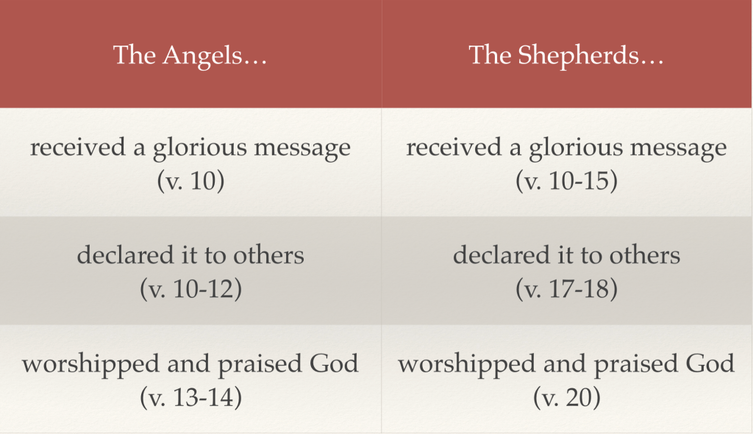 Not only did shepherds worship with the angels, but they even responded the same way.
And this pattern becomes an imperative to every reader. You’ve received the message. You’ve heard the good news. The hope of planet earth has finally come. This Christmas season, rejoice in awe together with the angels at what God has done. Tell anyone you can about this salvation that He has sent. And then fall before Him yourself and worship.
|
BJMBCReading, learning, growing. God calls us to be changed through His Word. At BJMBC, our goal is to speak truthfully and clearly about that Word, while we prepare a future generation of students to proclaim it. Archives
June 2026
Categories
All
|

 RSS Feed